
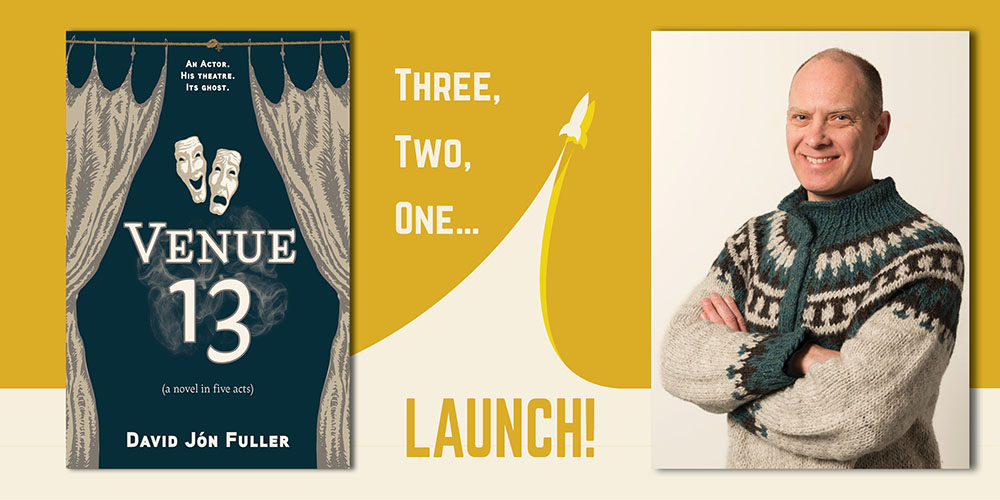
David Jón Fuller shares insight into his debut novel, Venue 13!
Congratulations on the publication of Venue 13! Venue13 includes pages of Robert's script throughout. Why was it important to you to share the one-man-play that Robert intends on performing with the books audience?
David Jón Fuller: Part of what I wanted to explore in Venue 13 was how the script format could allow Robert to break the fourth wall and speak directly to the reader. There are ways to do this in fiction, such as with a first-person narrative, but I wanted to show how for Robert, getting up onstage is actually freeing, and it allows him to speak to deeper truths about his own life. Much like the way a character aside to the audience does in a stage play. But since this is a novel, not a play, I also wanted there to be a fictional context for it. So in this case, Robert's using his own theatre stage to tell his stories, and it turns out the reader is not the only one listening.
As for how this might work out loud, I was inspired by two very different sources. One was the play *Stage Directions* by Israel Horovitz, in which the characters, having just attended a funeral, don't speak to each other—except via their stage directions, spoken aloud in lieu of dialogue. I saw this in a Fringe production and it worked beautifully. The other was the semi-ironic "Exit, stage right!" frequently uttered by Snagglepuss in the old Hanna-Barbera cartoons. There's also a real economy of language in a play script, and I wanted to use some of that via stage directions in novel. And finally, it's a novel set in a theatre, so I wanted to add a theatrical dimension to the narrative voice.
Details and descriptions of behind-the-scenes theatrical life really bring Venue 13 to life. You were part of the Winnipeg Fringe Fest scene for many years. What was it about this setting that inspired your debut novel?
David Jón Fuller: There's a rough-and-ready quality to the Winnipeg Fringe Theatre Festival that I fell in love with straight out of high school—no matter how polished the productions or seasoned the performers there was something quintessentially "Fringe" about the whole experience. I loved that you might be called up on stage by jugglers wielding knives and fire, or take in a haunting two-man show staged in a grotty parking garage down the street, or run in to a performer you'd just seen onstage waiting in line for someone else's show.
I also learned the hard way that putting on a show is a lot tougher than just getting together a group to write, rehearse and stage it. The first show I was in was by the aptly named Stage Fright—unfortunately we folded before the festival started. (We were in the program, though, and I heard we earned a Jenny Award in absentia for "Truth in Advertising.")
Just getting onstage was a victory—the next year I was in a different show with another company, and it was thrilling to get up and perform in amongst the much highwer-profile companies and Fringe legends. A bit humbling to get sparse attendance at some shows, not to mention a bad review. But it was a blast.
Over the next few years I got cast in different Fringe plays, getting to work with great actors and directors, sometimes even getting held over for Best of the Fringe. One of those was in a bring-your-own-venue show, where the company has to look after getting its own space to perform in and run it, which adds another level of logistics.
In the struggle to mount a production, never mind drum up audiences, weather the reviews, and, with any luck, make some money back, you really get to see people at their best (and sometimes their worst—myself included). But at the end of the run, it's a group effort, and there's always a feeling of accomplishment.
So all this seemed like fertile ground for behind-the-scenes drama. It certainly was in real life! Plus, I still love the Fringe, and have been involved with it on the other side, writing features about it or reviewing shows for Uptown magazine and later the Winnipeg Free Press. With Venue 13, I wanted to recreate the frenzy, hardship, and joy of that kind of summer theatre festival, at a fictionalized distance.
At the heart of this speculative fiction novel is a ghost story. Why choose the 'ghost story' genre to build VENUE 13 world in? Did the form free or structure your creativity?
David Jón Fuller: I think it's very much part of the Icelandic storytelling tradition to include a ghost, either literal or metaphorical, in a work of fiction, so to some extent I didn't think too hard about including it. It was there from the start. But of course a ghost is not only a ghost; in most haunted house stories it is tied to some dark secret the characters have to discover before it's too late. I wanted to explore that in both the main story — Robert has to not only overcome his disbelief in the supernatural in order to understand what is actually going wrong at Venue 13 — but in the theme of dredging up old ghosts, as it were. Robert has baggage he hasn't fully dealt with, and it repeatedly causes him problems in his day-to-day life. He has to confront those metaphorical ghosts while dealing with a literal ghost. And since if a spirit is sticking around for some reason or other, I gave Henry, the ghost, his own unfinished business to deal with before he can move on. And it so happens that Robert and Henry are the catalyst for each other, in different ways, to be able to get free of what's haunting them.
In terms of the kinds of story you can tell with a ghost, it can be very freeing. Every culture has some tradition of ghost stories, I think, all very different. For me, and this story in particular, I wanted to structure it so that the theatre itself was the thing that trapped each of them, in their own way, but also was the venue that set them free.
 Turnstone Press Ltd.


